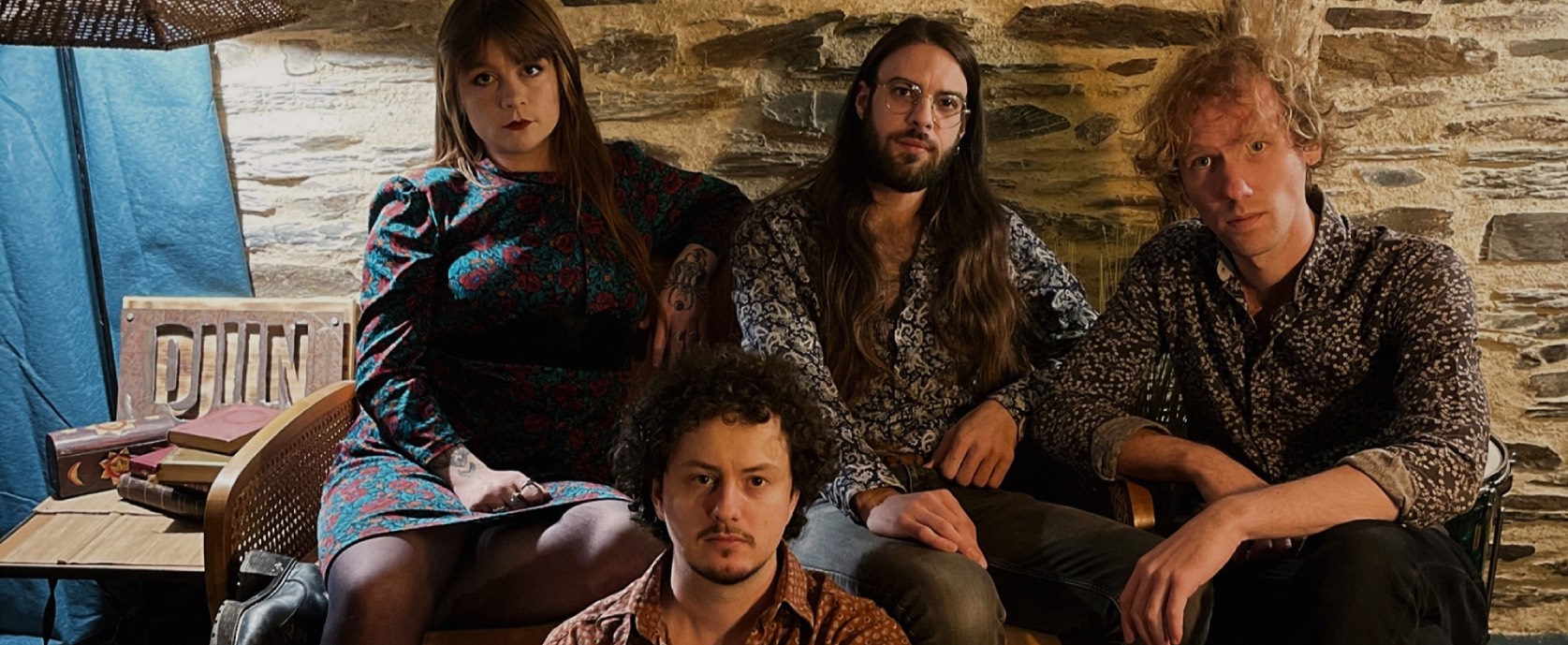
At times playful and steeped in the spirit of the 1970s, at others dark and hypnotic, the psychedelic rock sound of the French band Djiin is strikingly dual in nature, yet remarkably fresh and inspiring. This is partly due to the technical virtuosity the members display in their live performances, but above all to the unusual instrument that occupies center of the stage and shapes the band’s distinctive sonic identity.
Instead of a classic interview introduction, I’d like to give you some space to introduce yourselves. So, here you go – what do we need to know about Djiin? 🙂
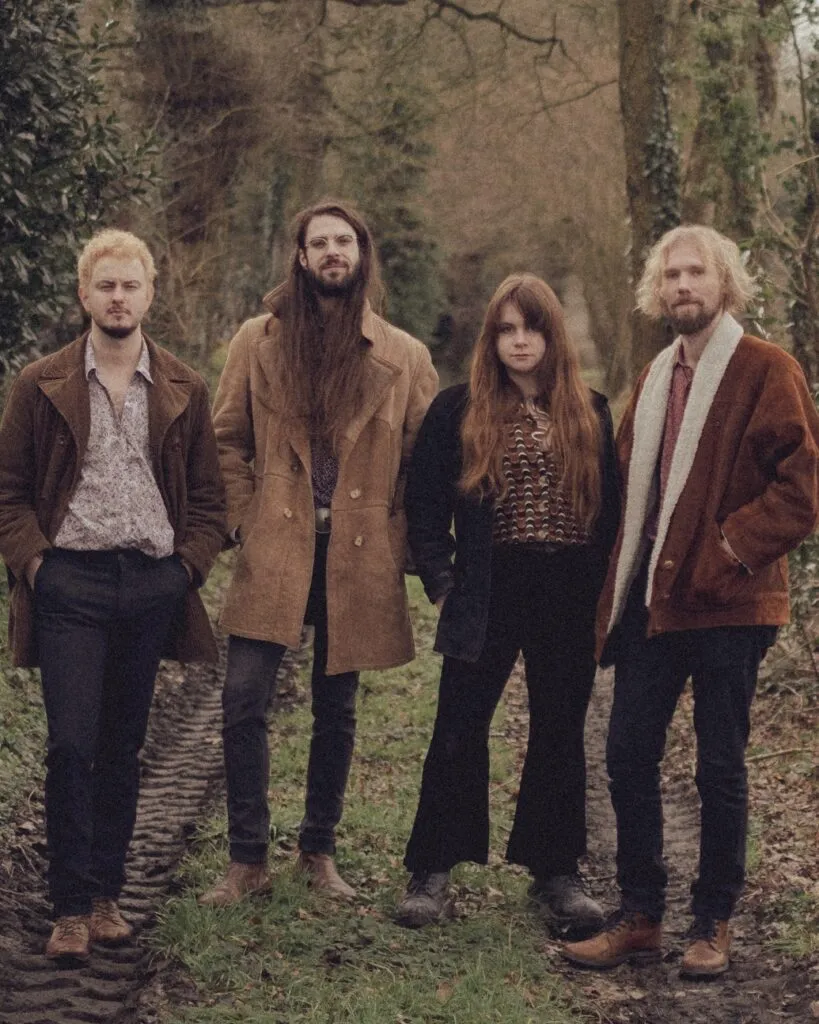
Djiin are Chloé (lead singer and electric celtic harp), Allan (drums), Charlélie (bass), and Gus (guitar and back singer) since 2025. We come from Rennes in France and we have been touring across Europe since 2016 and we like to explore dark and complex horizons to express our grieves, our rage, our love.
Your music speaks many languages. It travels back and forth between the psychedelia and progressive rock of the 1970s to the present day, with strong influences from stoner to doom. How did you shape your sound, and what did it take to get where you are now?
We each have many different influences. We also evolved a lot since our beginning 10 years ago, and are still discovering new inspirations. It sure feeds our music, but we try to fit an idea, a feeling or a story rather than thinking in terms of “genre”. It often starts with a riff, a melody or a jam, and when the topic of the song is set, we like to play with rhythms and harmonies and explore a lot of possibilities to picture it.
What was your “aha” moment when you said to yourself, “I’m going to make music”? Or, in the case of Djiin, “We’re going to create music together”?
It’s very simple : Our drummer Allan once heard Chloé’s deep voice in a pub, thought it would fit in a rock band and asked her to sing in his new project. Chloé also brought her celtic harp with her, which is an odd addition to a classical rock formation at first glance, but ended up being very original and fun to integrate along heavy riffs and psychedelic atmospheres.
What is life on tour like for you? I came across some information that in 2024, you played 35 concerts in a row across a large part of Europe. Is that a lot for you, or does it feel fairly “normal”?
Touring is a bit like living in a parallel universe. The rhythm can be intense, and sometimes you can feel disconnected from your daily habits, but we love to discover new places, new cultures, local bands, and to meet new people. We are also very grateful for being welcomed with love and kindness every time we leave home to share our music with people.
Easiest part of being a musician, and what is the hardest?
The easiest part is to buy an 8×10 Ampeg bass cab. The hardest is to lift it to the stage.
Your latest studio album, “Mirrors” (2024), tells five stories through the concept of juxtaposition – black and white, light and dark. It addresses difficult themes such as misogyny, violence, and death. How did you come up with the concept for this album?
Well, as the world is filled with such problems, it’s hard not to be afflicted by what we can see through our own eyes, through media or through our own life experiences. It was a cathartic way to deal with our own traumas and society’s issues. But when there is darkness, there is also light and hope hidden somewhere, and that’s what we wanted to conceptualize with “Mirrors”.
Your videos are very cinematic, somewhat trippy, and filled with symbols and rituals. Where do you find your inspiration?
We always liked to make music that tells stories, and we think that album covers and music videos are an expansion to it. But if these stories can be personal to us, we also want the people to take appropriation of them, and make them have their own interpretation of the songs.
It’s the same with the videos: we like to give free will to the artists who are working with us, to let them give their own visions of the songs. Of course we talk with them about our feelings, and what we wanted to say with the songs, but it’s important for us to let video makers do their own work, because if we chose them, it’s because we like their work and have trust in it.
What is the most important thing you want your audience to take away from your music?
We don’t really think about that when we create music, but we are always glad when people come to share their feelings with us or say that they identify themself in our songs. We love having a sincere connection with people who are listening to our music.
The band’s future in three words?
NEW.ALBUM.COMING
Photos: Djiin (promo)
Interviewer: Sara Jerman