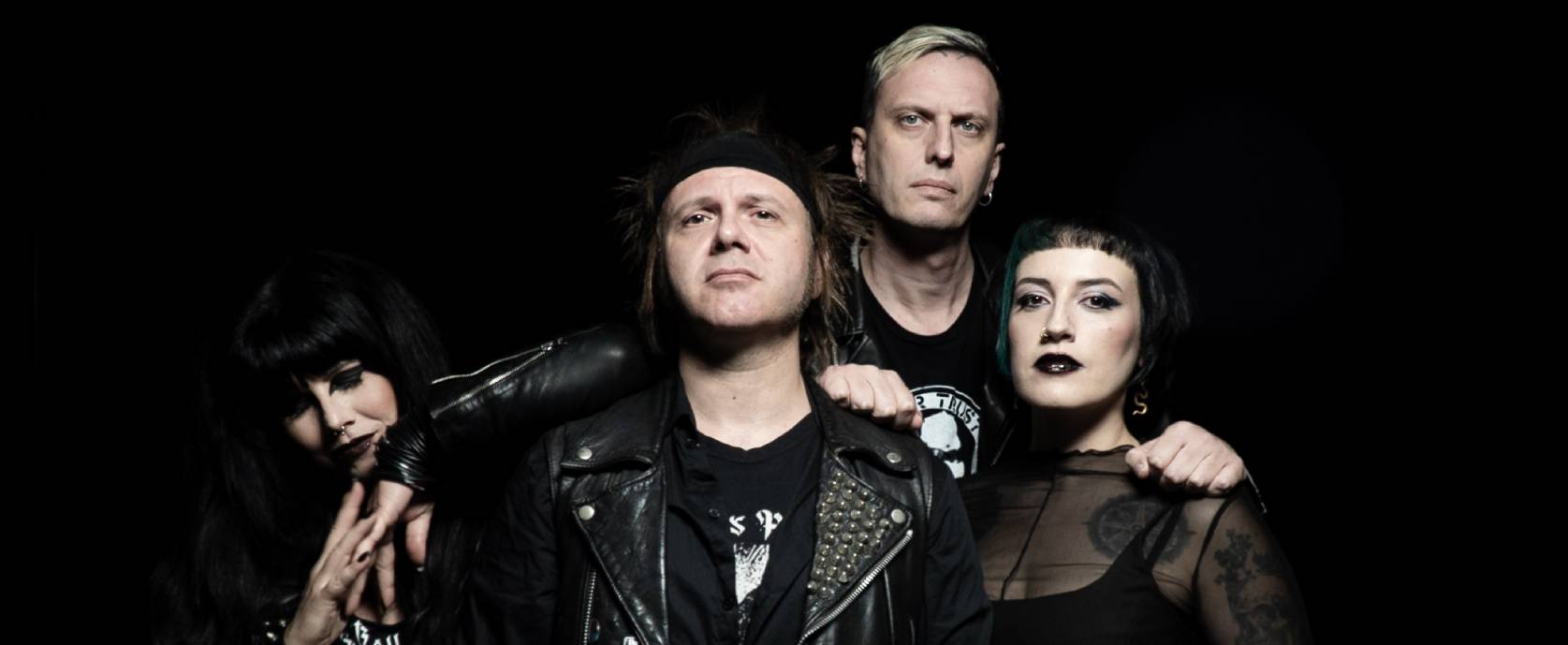
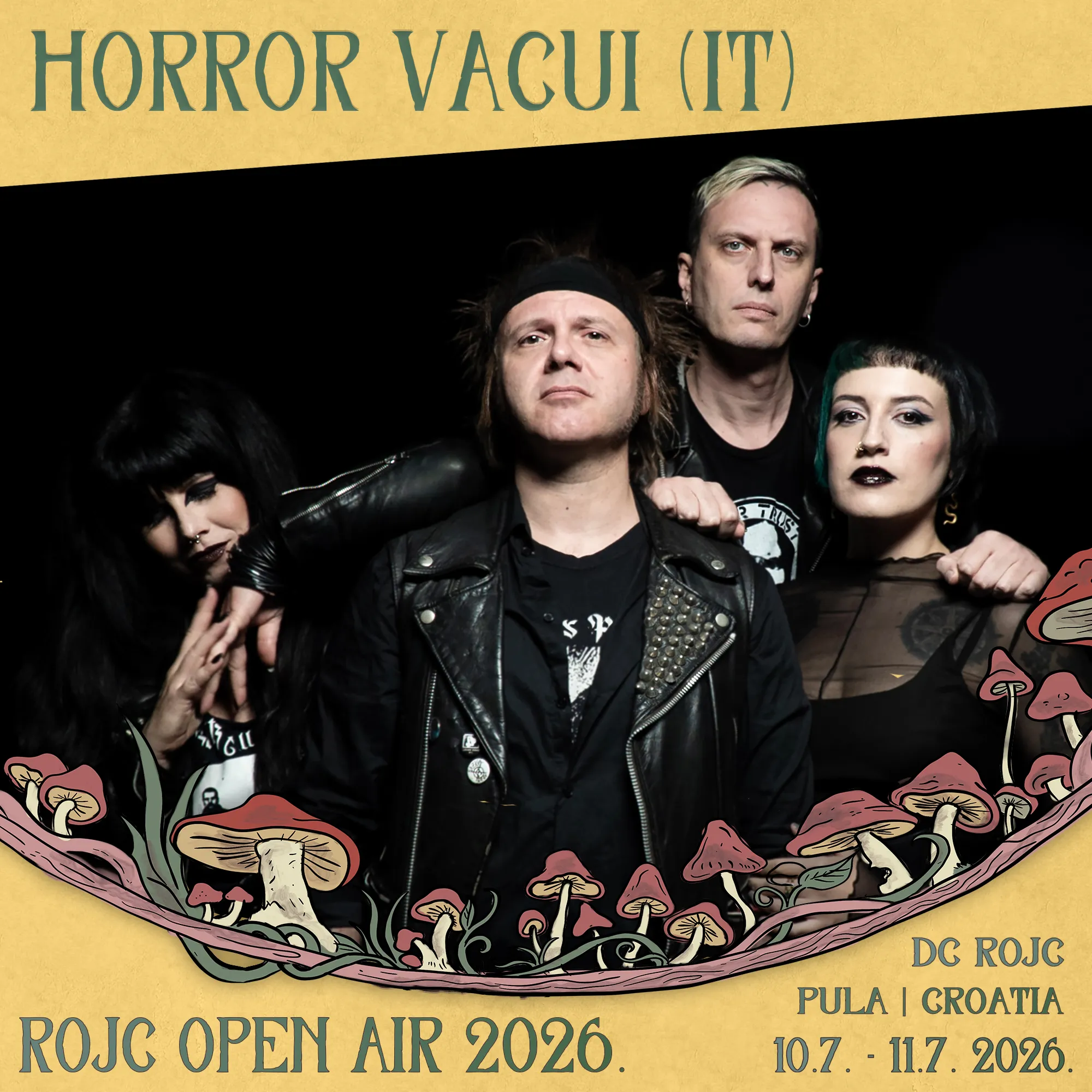
Horror Vacui stands as one of Europe's premier death-rock, goth and post-punk bands. With the honor of their performance at this year's Rojc Open Air Festival, we're diving deep into their art, the meaning behind it, the scene they thrive in, their wild experiences, and more. We learned a lot.
You describe your music as "punker than dark, darker than punk." What does that exactly mean?
We used that phrase for the very first time at our first show. Back then the band was still very much rooted in the punk scene and it felt like a good way to signal that this new project was heading somewhere slightly different, a way of saying we were moving away from the punk bands and scene we were involved with but at the same time we were rougher and more punk than what people would normally expect from a goth band. In Italy it's quite common to refer to goth bands simply as “dark” and since we had started building a small network of new friends in that scene, we wanted to make clear we weren't that kind of traditional goth band. At the beginning it was just a quick description but we never really replaced it with anything more precise, mainly because the band naturally evolved into something hybrid, somewhere between those two worlds that are both part of our roots. There was also a more practical side to it. Keeping a strong punk light and clearly belonging to that scene was a way of setting expectations, making sure we'd end up in the right venues and the right contexts. Especially back then, it was very easy to encounter people with political views very far from ours or “in it just for the music”, so we wanted everyone to know what to expect from us from the start.
You’re from Bologna, but originally from various Italian cities. Can you describe the alternative scene in Italy and its current state?
The alternative scene in Italy is a bit like our cuisine: very diverse and changing from region to region. Some areas are more receptive to certain genres than others. It can be rich and experimental but it can also be very traditional. Overall, we think the scene is fairly healthy, but it’s important to consider the context in which it exists. Italy unfortunately remains one of the European countries with the lowest levels of investment in culture in every sense. Governments, especially the current far right fascist one, are actually divesting from the sector and making things increasingly difficult, from evictions to the criminalization of spontaneous art or practices intended as no profit. There is very little funding, support or institutional recognition for art in many of its forms, which means most people involved in bands, venues or cultural events are doing it alongside a full time job. That reality obviously affects how much music or art a person can produce and it shapes the overall cultural landscape. When you compare it with countries where culture is more supported, the difference becomes very clear. Because of this, we think Italy is a very resilient country creatively, people, venues and promoters often have to struggle just to make things happen but they still find ways to create.
That spirit probably comes from the variety we're surrounded by, different histories, influences and traditions constantly mixing together and functionally a fuel for inspiration. If there were stronger political and institutional support, the results would undoubtedly be even more vibrant, we could go on very long on this topic. Right now many people are forced to balance their job, their family and their artistic passions and sometimes you have to choose where your energy and time goes. The geographical divide between north and south adds another layer of complexity in maintaining a balanced live circuit across the whole territory which is extended and long. Still, it's always inspiring to see new promoters, collectives and venues working hard to expand the cultural offer despite all these challenges, we are thankful to each of them.
After numerous genres that the members played through the years (from crust punk, post-hardcore to d-beat, etc.), you decided to settle into death rock/post-punk. As I read, you were influenced by the London goth scene?
Yes, we had a strong connection with the London goth scene, especially in the early 2000s. London has been the place where our singer Koppa had the idea to form the band that he eventually started in 2011. At that time, 20 years ago now and when we were around 20/25, some of us moved there and that experience played an important role in our development because it exposed us to something quite unconventional for us at the time. We had grown up almost entirely within the punk underground, going to shows in squats and hanging out in DIY spaces so the idea of going clubbing was something we had never really considered. In London, that kind of mixed approach was much more common. People would go to clubs both to dance and to watch live shows and different scenes often shared the same spaces. In Italy back then those worlds were much more separated. If you were part of the punk underground, you stayed in squats and DIY spaces, clubs were usually associated with the more commercial side of metal, goth or mainstream music. Living in London was a turning point for us. It showed us that people could actively experience music across many different contexts, and that those worlds didn't have to be kept apart. Today that kind of mixture is becoming more common in Italy too but at the beginning of the 2000s it felt very new to us. In that sense, London was definitely a teacher.
What influences your music the most, and has that influence changed over time?
Over the years most members were closely connected to the hardcore and crust punk scene, especially in the first decade. Since around 2023 the lineup has also included people from different backgrounds, bringing metal and even folk influences but we love many music genres. We focused more on this project as the scene in Italy changed. Some of our previous bands mainly made sense within specific environments like squats and self-managed spaces. As repression of squats increased, many of those places disappeared, along with key reference points for that activity. This shift wasn’t lighthearted. It was part of a broader process tied to growing up, developing a personal approach to activism that sometimes clashes with newer forms of participation, communication and the natural way life reshapes priorities. Music wise, in the beginning our music was strongly influenced by traditional goth and by bands that stood at the border between goth and punk, like Screaming Dead, Blitz, Corpus Delicti and Musta Paraati, bands that showed us it was possible to move between those two worlds while keeping a raw and direct approach.
Our early recordings were also shaped by a period of research, trying to understand what our own sound could be while keeping a spontaneous and genuine approach. It’s becoming more and more unconventional to have a full lineup with drums, bass, two guitars and five members but we believe the core of a band is a group of friends. For us, that’s the main reason a band should exist, especially as we grow up without giving up those feelings and because we still believe that building a great shared memory together is something worth fighting for. More recently we've tried to experiment a bit more in terms of sound, even though our formula is still quite classic: strong lead guitar riffs and the dark atmospheres typical of the 1980s. We're not a particularly technical band and that direct and instinctive approach is something we want to keep. The direction of the songs often follows the inspiration and mood we're experiencing at a given moment: if we feel more energetic the music becomes more driven, if we're in a more introspective phase that feeling naturally emerges in the atmosphere. Right now we're living a very positive and stable moment, surrounded by many supportive and inspiring friends and members with shared visions. That energy is pushing us forward and we feel the most prolific period for the band is still ahead of us.
What are three non-negotiable things in your music artistry?
This is a very important question because being a long-existing band often puts us in front of constantly changing situations. Over the years we’ve seen how contexts, expectations and compromises evolve, and we are aware that the balance between those things can shift from one period to another. At the same time, we know that it’s impossible to be perfectly coherent in every situation and we are also aware that we are not going to change the world on our own. Still, there are a few things that for us are non-negotiable.
First of all, politics are pretty much non-negotiable for us. Of course we know that compromises are sometimes part of the modern world and we always try to approach things in a peaceful way, but we also try to remain aware of our position and our ideas. Even if we know we may not change the world, it’s still important for us to be conscious of what we stand for.
Integrity is also non-negotiable. We’ve always chosen to be ourselves without bending to trends or adapting just to gain visibility. In the current music landscape, exposure is often linked to how much a band can fit into different contexts or become a kind of product that works everywhere. We understand that dynamic but we prefer to accept smaller numbers or less visibility rather than compromise our identity.
Another important principle for us is being honest about ourselves and our reality. All of us have full time jobs and busy lives during the week and our free time is limited. This has always been a limit for us, it means we can’t always do what other bands do, like touring constantly or being on the road for long periods. Because of that, mutual comprehension and respect within the band is essential. We try to be super scheduled, organized and clear with each other, and we expect the same from the people we share music with. For us, respecting everyone’s time and private life is fundamental, for example showing care for sharing info as soon as we have it in order to allow everyone to reshape priorities. Time is precious, especially for people who balance music with full time jobs. Every moment we dedicate to the band is something we take from other parts of our lives without an income to counterbalance it, so we believe it’s important that this commitment is respected by everyone involved, being serious and clear in communication. There’s no time to lose nor place for superficiality.
You’ve toured all over the world, from the UK to Spain, USA, Canada, Mexico… What's the most unusual experience you remember?
Honestly, some of the most unusual things we can remember from our tours is just sleeping in hostels or hotels. We're so not used to that, we're more accustomed to crashing on floors, in vans or next to dogs so when we finally get a proper bed with breakfast included, we feel like the royal family. And yes, we're totally joking about that. Our drummer keeps diaries and she has an entire library of crazy stories from tours around the world. Once in California we had no idea where we'd sleep for the night and a guy from the crowd offered us a place just across the street, super fancy, with a driveway for the van and gear. It should have been perfect but our guitarist didn't sleep at all because she was convinced he was a serial killer because he was way too nice and generous to be real. Thankfully everything turned out fine and it's one of those stories we still laugh about. Other examples are we almost got deported on the Canada-US route over a mix-up with our IDs and we were all dressed up in civil clothes looking totally stupid. In Germany we had to flee authorities who wanted to impound our rusty yet perfectly revisioned van so we were on the run in the country for 3 days filled with paranoia and desire to fight the (unfair) law ehehe.
Birds once took over our sleeping area and we had to shoo them away with a tennis racket. During our second US tour our van broke down in the middle of nowhere and our guitarist had to step in and sing while the actual singer was still racing to the show in a separate last minute van rescue, terrifying performance. He eventually arrived at the end of the last song and we played the set again, but somehow the audience loved the previous singing that was horrible hah. Once we got surrounded by the narcos that robbed the venue. Every tour has moments like these. Last summer our bass player did the laundry without emptying the dirty clothes bag. Earlier he had put a sandwich in it so he could eat it later (excellent choice of storage). The bag went straight into the washing machine with everyone else’s clothes, about a 7 kg load. The result: a washing machine full of floating peas, soggy bread, bits of vegetables and shredded paper. We then spent the next two hours fishing sandwich debris out of everyone’s laundry. They're chaotic, unpredictable and hilarious and they end up being the stories we remember and laugh about for years.
Do you prefer festivals or club concerts? Which one gives a better atmosphere? Is the atmosphere something you care about the most?
For us the atmosphere is very important and sometimes it gathers more attention while giving feedback than the performance itself or the sales or the overall feeling. Festivals are great in many ways, they give you the chills and visibility, and the pictures are always amazing and for free hahah. Anyway the atmosphere you get in a small club is unlike anything else. For a long time house shows were our top pics but as the equipment doubles it’s hard to have a good result in such small places. We’d love to say we prefer festivals but honestly we’re not used to playing big ones yet and it’s hard to compare. Over time, we’re curious to see what our true preferences will be. One thing we love about festivals is the possibility of meeting and sharing the stage with artists we’ve loved as fans and that’s a huge part of the joy of performing. But if we talk purely about music, atmosphere and the full experience of a show, club concerts are absolutely the best for us at the moment.
Do you know any Croatian or regional band(s) you like?
We know a lot of old hardcore punk bands like U.B.R., TOZIBABE, DISTRESS, 2 MINUTA MRZNJE, PATARENI, ODPADKI CIVILIZACIJE, PANKRTI, PARAF, POGREB, SATAN PANONSKI, NECROPHILIA, SOLUNSKI FRONT, SKOL, G.B.M, BUKA, FAKOFBOLAN, NULLA OSTA, PROBLEMI, TERMITI, PLASTIKA, KORIDOR, KPAX, EPIDEMIJA. and we can go on for hours 🙂
What is the last music piece you listened to?
Koppa: Right now I’m listening to “Love is pain” by The Spoiled, a present Italian post punk act. A few hours ago I spinned The Damned first LP, then Siouxsie And The Banshees “Juju”, then Twin Tribes “Ceremony”.
Marzia: I just listened to the split between Ruhr and Shocked Volk, two Berlin/Helsinki Italian cold wave/electronic solo acts, the last Home Front Lp, “Delirio” from Lifeless Past, a goth-post punk duo based in the Netherlands, the last Lp by Nyx Division, Malaria! because today the singer passed away and Blitz because it’s always time for Blitz.
Interviewer: Sara Jerman